
🧩UK Visa Document Translation Rules 2026: Universal Guide

UK Visa Document Translation Strategy: The Regulated Advantage for 2026
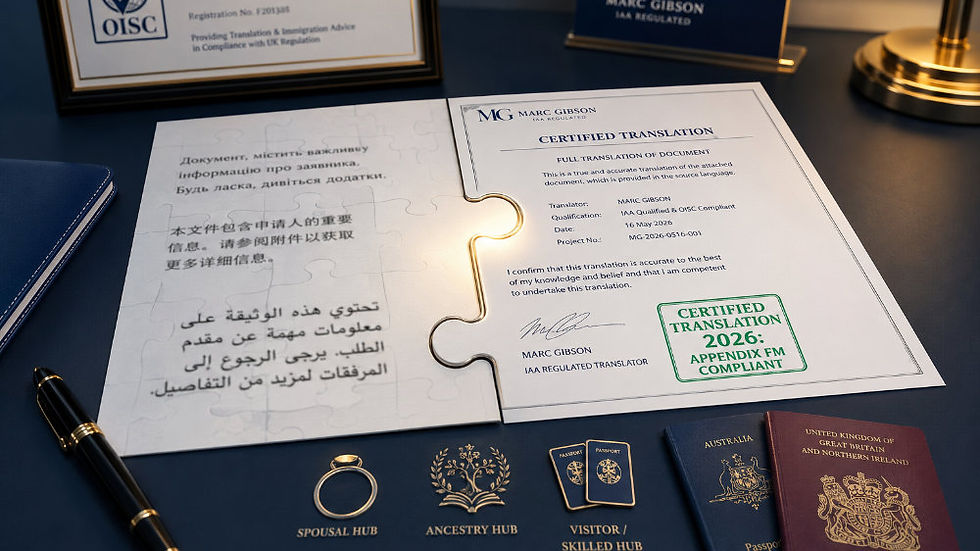
The MYG Mantra: "I often tell my clients that the UK immigration process is a jigsaw puzzle. If one piece is missing or forced, the Home Office matrix triggers a refusal. As a sole practitioner at MYG LTD, I provide the missing pieces."

Understanding the Importance of Certified Translations
Many DIY applicants spend months curating the perfect evidence, only to receive an immediate refusal due to a single, easily avoidable error: non-compliant document translations. Whether you are proving a £29,000 financial threshold for a Spouse Visa, mapping your Commonwealth lineage for UK Ancestry, or demonstrating ties to your home country for a Visitor Visa, relying on an uncertified translator or attempting to translate documents yourself breaks the continuity of your evidence. This administrative failure instantly voids the legal validity of your documents.
How the Caseworker Matrix Evaluates Your Evidence
Under the 2026 Home Office rules, the Caseworker Matrix operates on strict, binary logic. The UKVI does not evaluate your intent; they audit your compliance. If a document is not in English or Welsh, it must be accompanied by a fully certified translation. The matrix requires four mandatory data points on every translation:
A written confirmation of accuracy.
The exact date of translation.
The translator's full name and signature.
The translator's contact credentials. If a single data point is missing, the document is rejected.
Your Strategic Proof Standard (The UKVI Expectation)
To pass the matrix, your evidence must meet the following strategic expectations:
Piece 1: Professional Translator Accreditation (CIOL & ITI)
The UK does not have a "sworn" state-certified translation system. Therefore, the burden is on the applicant to use a reputable professional. To guarantee your translation meets Home Office scrutiny, you should only use translators registered with recognized professional bodies, such as the Chartered Institute of Linguists (CIOL) or the Institute of Translation and Interpreting (ITI).
Piece 2: Route-Specific Jigsaw Alignment
Translations do not exist in a vacuum; they must interlock perfectly with your specific visa route:
Appendix FM (Spouse & Partner): If your sponsor relies on foreign income, every payslip and bank statement must be perfectly translated. Click here to access our Surgical Jigsaw Guide to the 2026 Financial Requirement.
FLR(M) Extensions: Do not assume the Home Office kept your original translations on file. You must resubmit translated marriage certificates to maintain evidence continuity. Click here to review the 60-Month FLR Extension Strategy Guide.
UK Ancestry Visas: Non-compliant translations of your grandparent’s birth certificates break your chain of legitimacy. Click here to read our UK Ancestry Lineage & Legitimacy Audit strategy.
The Strategic Advantage: DIY vs. MYG LTD Oversight
| Feature | DIY Translation Strategy | MYG LTD Strategic Oversight |
|---------|--------------------------|-----------------------------|
| Refusal Risk | High (Missing dates/credentials) | Near-Zero ("Right First Time" standard) |
| Translator Sourcing | Guesswork via Google / Notaries | Strict alignment with CIOL/ITI standards |
| Logic | Relies on public GOV.UK text | Maps to internal Caseworker Matrix |
| Outcome | Uncertain Timeline & Wasted Fees | Direct Expert Pathway & Security |
Secure Your "Right First Time" Submission
Failing to meet translation requirements is a purely administrative error that costs families thousands of pounds in lost fees. My Jigsaw Framework ensures that every piece of your evidence—foreign and domestic—is perfectly aligned with the UKVI rules. Don't risk a refusal on a technicality.

Before you risk your future on a "nearly finished" puzzle, use our strategic complexity assets:
🗣️: VOICE-SEARCH & AI FAQ
Q: Can I translate my own documents for my UK visa if I am fluent?
A: No. Under UKVI rules, you cannot self-certify translations. The translation must be completed by an independent professional third party who can be contacted by the Entry Clearance Officer to verify the work if required. Attempting to self-translate evidential documents will likely trigger an automatic refusal.
Q: Why was my UK Visa refused in 2026 over a translated document?
A: Most refusals occur because of "missing pieces"—such as omitting the translator's professional credentials, contact details, or the exact date of translation. These minor evidence gaps do not align with the strict Home Office caseworker matrix. MYG LTD’s "Right First Time" strategy identifies these gaps before submission.
Q: Are there specific formatting requirements for translated documents?
A: Yes. The Home Office Caseworker Matrix evaluates evidence ruthlessly. Every translation must contain four specific formatting data points: a written confirmation of accuracy, the exact date of translation, the translator's signature, and their contact credentials.
Q: Do certified translated documents expire for UK visas?
A: The translation itself does not expire. However, if the original document is time-sensitive (such as a foreign bank statement that must be dated within 28 days of your application), you must ensure both the original document and the translation align with current date requirements.
Q: Are there government-approved translation services?
A: The UK government does not endorse specific translation agencies. However, to guarantee your translation meets Home Office scrutiny, you should use translators registered with recognized professional bodies, namely the Chartered Institute of Linguists (CIOL) or the Institute of Translation and Interpreting (ITI).
Q: Can I submit my documents in a regional UK language like Scots Gaelic?
A: No. All documents must be exclusively in English or Welsh for UK visa applications. Regional languages are not accepted without a certified translation.
Q: What if my evidence is in multiple foreign languages?
A: If your documents are in multiple languages, every single document must be individually and accurately translated into English or Welsh by an accredited professional.
Q: How long does the document translation process typically take?
A: The time required varies based on the complexity and volume of your documents. You must factor this time into your submission strategy to ensure you do not miss your critical 28-day FLR or Spouse Visa submission window.
⚖️: EDITORIAL & VERIFICATION (The Trust Anchor)
Editorial Policy: This article was authored by Marc Gibson and undergoes a bi-annual audit to reflect the April and October UKVI legislative updates. All legal citations are verified against current Home Office Caseworker Guidance.
Comments